
Anxiety has been put in the spotlight recently, in part thanks to the bright orange character in Pixar’s “Inside Out 2.” In the film, anxiety impacts the competitive abilities of an adolescent athlete. In our world, the same thing happens to athletes of all ages. Michael Medina, who graduated from Hastings College May 9 with a degree in psychology, took the concept and applied it to collegiate golfers as part of his senior capstone project.
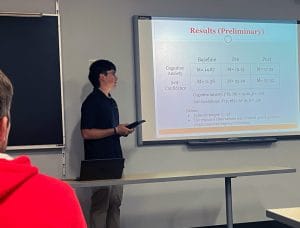
Medina, a collegiate golfer himself, presented his research project at Academic Showcase, a day in the spring where students get an opportunity to share their research and other projects with the community.
His research focused on anxiety and the ways it impacts collegiate athletes. While Medina said pre-competition anxiety can act as a motivator, he also pointed out that motivation must be learned.
Medina’s study was based in Multi-Dimensional Anxiety Theory, which uses an individual’s cognitive responses — such as brain fog or self confidence — to predict an athlete’s performance. Alongside this, he talks about physiological responses to anxiety, such as sweating, muscle tension and heart rate and how they may help or harm an athlete.
Medina first presented an overview of three studies he’d used for his capstone, followed by the study he created himself. His hypothesis suggested that golfers with a high pre-competition anxiety will likely have lower performance, and the same for golfers with low self-confidence.
Low self-confidence impacted athletes who were considered losing players, which also spiked their cognitive anxiety. This combination led to higher pre-competition anxiety for future games, which created a vicious cycle before, during, and even after competition.
“I wanted to focus on the negative impacts of this type of anxiety,” Medina said.
The study had 27 Great Plains Athletic Conference (GPAC) golfers, 21 male, and six female. The participants were from three colleges: Hastings College, Morningside University and Doane University. Medina had participants take surveys 24 hours before competition, one to two hours before tee time, and another survey one to two hours post competition.
Medina said that he would like to further this study.
“I would suggest looking at directionality within golfers’ anxiety,” he said. He went on to explain this as looking at how golfers interpret their anxiety, asking if they’d use it as motivation, or lose it to stress.
Medina emphasized the importance of physical changes in collegiate sports to help both teams and individual athletes. He said he believes it is within a coach’s best interest to be able to understand and assist their athletes. He also suggested, if possible, hiring a sports psychologist, someone who understands athletic anxiety and can help an individual overcome it with goal-setting, pre-competition routines and other skills.