
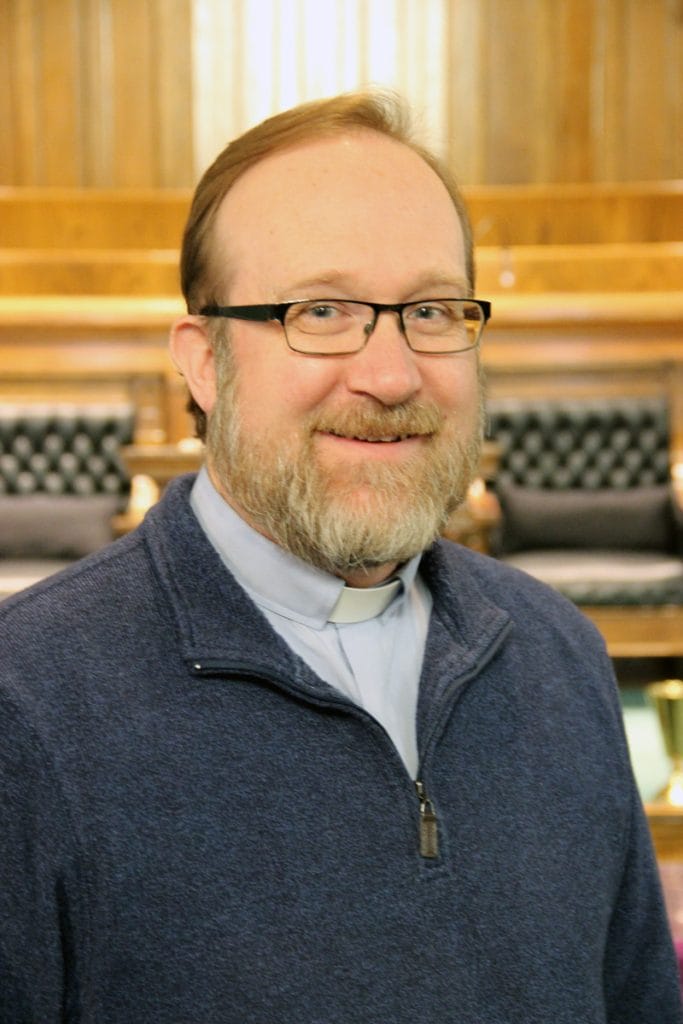
Rev. Greg Allen-Pickett is senior pastor at First Presbyterian Church of Hastings and a member of Hastings College’s Board of Trustees and ASPIRE Faith Advisory Council. In addition to pastoral leadership experience, he has leadership and management experience in for-profit and nonprofit contexts, as well as executive leadership experience at the Presbyterian Church (USA) denominational offices.
Allen-Pickett graduated cum laude with a bachelor’s degree in political science from Pacific Lutheran University in Tacoma, Washington, and was a Rotary Scholar in Ecuador for a year. He earned a master of arts degree from the Korbel School of International Studies at the University of Denver and a master of divinity degree from Austin Presbyterian Theological Seminary.
He writes for Presbyterian Outlook magazine and recently signed a contract with Wipf and Stock Publishers for a book titled, “Purple Church, Red State: Finding Common Ground in an Age of Polarization.”
Allen-Pickett is married to Dr. Jessica Allen-Pickett, assistant professor of teacher education at Hastings College. He writes, “We have a brilliant teenage daughter, Esther, and two ridiculous Lab mix dogs that we walk around the Hastings College campus almost every day.”
This story originally appeared in the 2025 HC Today.
Question: You’re writing a book exploring how faith communities can find common ground in an age of polarization. What have you learned in your work for the church that might help those facing tough conversations in other venues, such as in the workplace or with friends and family?
Pastoring First Presbyterian of Hastings has taught me that polarization is less a problem to be solved than a relationship to be tended. In the book, I tell the story of our Sunday Night Supper Series, where Democrats, Republicans and independents passed chili and Jell-O salads around the same table. The secret was not a clever debate format; it was three spiritual practices we borrowed from the communion liturgy:
- Confession—we began by naming our own limits (“Here’s where I may be wrong…”).
- Thanksgiving—we looked for something we genuinely admired in the other’s story.
- Commitment—we asked, “What can we do together for the common good this week?”
That rhythm lowers defenses, shifts the focus from winning to belonging and produces concrete, shared action (assembling sack lunches, collecting supplies for immigrants, building Habitat houses). The same pattern: humble self-awareness, grateful listening and shared action to benefit the community translates surprisingly well to staff meetings, family dinners or city council hearings.
Question: Karen Doerr, a donor to the new Doerr Center for Civic Engagement, said the Center will help students “develop skills to learn, listen and speak with a critical mind and open heart.” What techniques or practices can help us remain both analytical and empathetic as we engage with people who hold differing opinions?
Karen is a beloved and wise member of my church, and she serves on our leadership council. Her phrase, “critical mind and open heart,” names a tension we can train for. Three practices from our congregation help:
- Curiosity before critique: We encourage people to share a personal story that shaped their view. Neuroscience shows us that narratives engage the empathic right brain first; analysis can follow without contempt.
- Assume the best of intentions: Even if we fundamentally disagree with someone, start with the belief that you have similar goals or desired outcomes, just different ways of achieving those goals. This helps us find common ground in the face of differing opinions.
- The “plumb line” question – borrowed from the Old Testament prophets: How will this idea affect the most vulnerable? That keeps our analysis tethered to empathy and focused on others instead of ourselves.
These practices can let our minds stay analytically sharp while also engaging with an open and empathetic heart.
Question: What gives you hope that our society can move toward greater trust, understanding and constructive dialogue?
I’m hopeful because I’ve watched a shared mission override suspicion. Time and time again, people unite around serving others. Serving together rewires our perceptions and polarization in real time.
I’m hopeful because young adults are allergic to hypocrisy; they demand authenticity and are quick to collaborate on tangible goals. I’ve watched this in partnerships between Hastings College students and our church, whether it was a mission trip to the US-Mexico border or a food and hygiene supplies drive.
I’m hopeful because Hastings College and our faith communities have traditions and resources that help us transcend polarization: shared meals around tables that welcome everyone, the liturgy that teaches confession and forgiveness, the biblical vision that every person bears the image of God. When communities put these ideas into practice publicly and regularly, then understanding and dialogue find fertile ground.
Finally, I’m hopeful because I’ve seen our purple church in a deep red state become a laboratory of compassion rather than combat. If it can happen on the corner of 7th and Lincoln, and it can happen on the Hastings College campus, then it can happen in our community and across our nation.