
Hall of Famer may be scaling back, but he’s still in the lineup on and off campus.
Jim Boeve jokes that he’s better at the things he volunteers for than what he’s been paid to do for nearly four decades.
And the irony is, Boeve can’t stay away from any of it. Even though he announced his retirement from Hastings College after more than three decades, and retired — sort of — over the summer.
It took all of a few months for Boeve to be lured back into teaching at HC, where he spent 35 years as some combination of head baseball coach, registrar and mathematics professor.
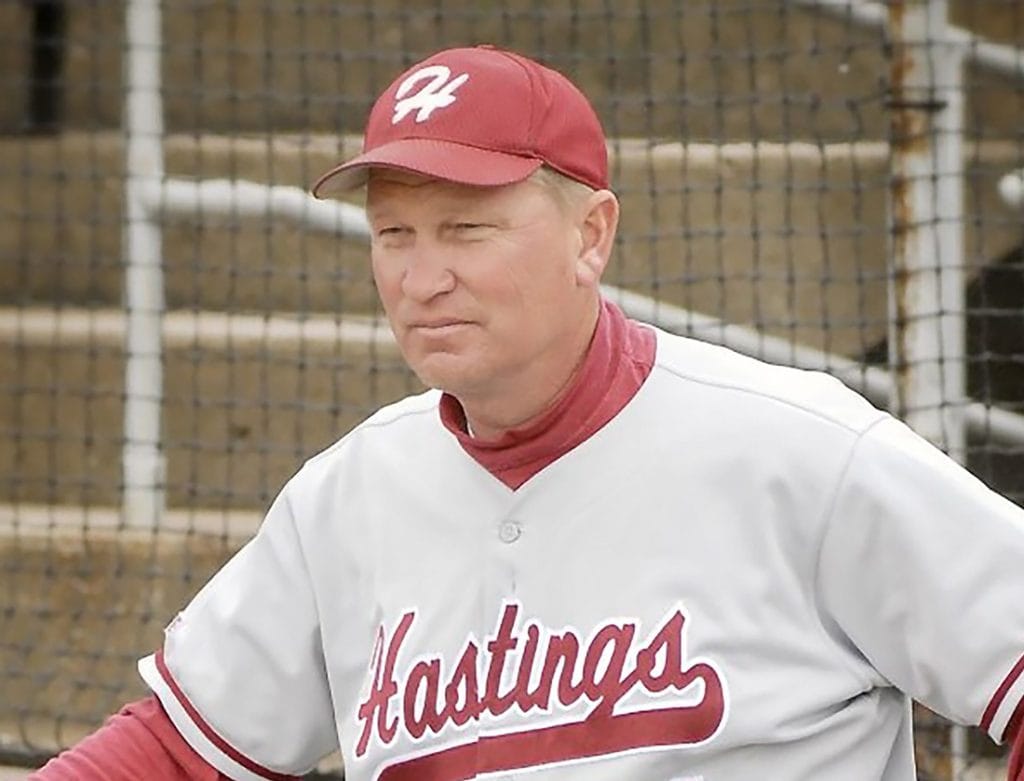
He taught statistics in the fall, as well as continued working part-time in the Registrar’s Office, mostly with athletic eligibility, to ease the transition to new leadership.
On top of that, he continues serving a fifth-term on the Hastings Public Schools Board of Education, and as chair of the NAIA baseball selection committee.
“I love doing both,” Boeve said.
Truthfully, Boeve loves it all. He just wanted to take a step back from full-time work.
Understandable, as his two children, Jennifer and Mike, adapt to their adult lives and Boeve, 65, continues to battle a cancer diagnosis. His wife, Traci (Rosberg) Boeve ‘93, moved into a new role over the summer as the College’s Dean of Enrollment and Financial Aid.
“I was just ready for a slowdown,” Boeve said. “I didn’t want to go cold turkey.”
It has been a gradual scale-back for Boeve, who retired as head baseball coach in May 2013 after 24 seasons, which included nine conference titles (seven regular season and two tournament) and a career 572-635 record.
But he has always epitomized dedication, particularly to the sport, and was rewarded for it.
In 2010, Boeve was inducted into the NAIA Hall of Fame for meritorious service, and two years later received the Robert E. “Ish” Smith Award, which honors unselfish promotion of baseball.
“I guess I just always felt like if you’re going to be involved, be involved at all levels of it,” Boeve said.
He was instrumental in the NAIA’s creation of Champions of Character, which aims to keep five core values — integrity, respect, responsibility, sportsmanship, and servant leadership — centric in sports, and also introduced the governing body’s current postseason format.
In 2023, Boeve was inducted into the Nebraska Baseball Hall of Fame, a feat he says he now has more perspective on, as well as the Hastings College Athletic Hall of Fame.
“You don’t think about all that goes into it when you’re the one being named,” said Boeve . “As you start nominating and recognizing people on these committees, you realize it’s more special than what you appreciated when you went in.”
While Boeve’s name is most synonymous with baseball, his impact as the College’s registrar and member of various committees and groups, both local and national, can be measured by similar metrics.
Perhaps the most influential was his time as chair of the “Implementation Group,” or IG, a committee that brings together representatives from every administrative office and faculty, and plays a key role in campus-wide planning and initiatives while serving as a feedback resource for College leadership.
“What gave us some satisfaction,” Boeve said, “is the accreditation team that came through last spring commended us on having this group to look at all the details of initiatives and things like that, and the workings of the College.”
The Higher Learning Commission team described IG as “a laudable component of Hastings’ governance system and valued across campus,” and that it could serve as a model for other institutions to borrow from because it ensures consistent collaborative planning and conveys deep agency to all constituencies.
Those on the committee for any length of time remember its early days, with Boeve at his best, chalk in hand in a nondescript classroom in the lower level of Hurley-McDonald Hall.
All of that extra effort has helped set the College up for years of success.
Just how many of those will Boeve still be involved? Even with more than three and a half decades behind him, he isn’t sure.
“I could see myself doing it for a while,” Boeve said.