
Wildfires are dangerous, unpredictable and capable of changing in seconds. While most people picture engines rolling toward a fire, Hastings College wildlife biology major Jaedyn Adler drops directly into the blaze by helicopter.
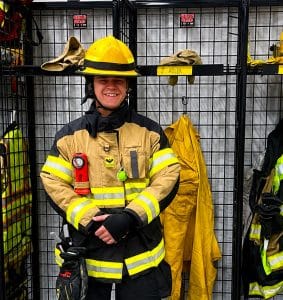
Armed with only what he can carry, the senior and his crew are tasked with containing the fire until backup arrives. This summer, Adler — an Evans, Colorado, native and firefighter with the Hastings Rural Volunteer Fire Department — did just that as a seasonal wildland firefighter with the U.S. Forest Service.
With the assistance of Carissa Uhrmacher, director of Hastings College Career Services, Adler worked through perfecting a federal resume before submitting his application to fill the seasonal position of wildland firefighter with the Black Hills helitack crew in Custer, South Dakota. He waited four months before receiving his official job offer in February.
On the helitack crew, Adler acts as a Type 2 firefighter and helicopter crew member, with the primary role of fire suppression.
“No two days are the same,” Adler said. “Some missions, we drop in with hand tools and chainsaws and work the fire. Other missions, we’re setting up the helicopter’s bucket and calling in water drops over the radio.”
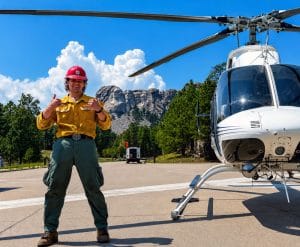 Outside of his direct support on the ground, Adler also serves as an Air Base Radio Operator (ABRO), coordinating helicopter operations from the base. This requires monitoring up to seven radio frequencies while communicating with pilots, Air Attack, ground resources and dispatch centers.
On top of that, Adler has to document operational data in both digital systems and handwritten logs.
Adler’s first experience as an ABRO was on deployment to Utah, where he found himself learning how to operate all of these communication systems by himself.
“I didn’t even know what ABRO stood for,” Adler said. “I’d never traveled alone as a single resource on a fire assignment, either.”
Adler had to learn to think ahead and anticipate what the helicopter, pilot or crew would need next. This applied to everyday tasks as well. If Adler has downtime, it is spent cleaning equipment, organizing gear and asking questions.
Adler expressed interest in aviation and complimented the team dynamic. He now has experience working alongside firefighters and pilots who have been more than happy to teach him and keep him on track during high-pressure situations.
Adler’s first challenge was getting over his fear of heights.
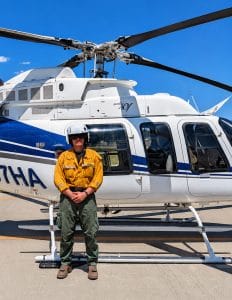 “Looking back, applying for a job where the main responsibility is flying around in a helicopter was probably not my brightest idea,” Adler said with a laugh.
Despite his initial fear, he said flying is now one of his favorite parts of the job.
Adler’s biggest challenge was taking in a lot of different information at once. He entered the position with no aviation background, but brought previous wildland fire experience with him.
He credited Dr. Anna Hiatt, an assistant professor of biology at Hastings College who teaches Fire Ecology, with strengthening his understanding of fire behavior, fuels and weather influences on fire — knowledge he relied on heavily while working active wildfires.
“This job has been one of the most challenging and rewarding experiences of my life,” Adler said. “I want to continue helping others, no matter where my path takes me.”
Adler’s long-term goal is to become a game warden, but his experience with helitack has broadened his perspective on what that career could look like. He is also interested in opportunities involving aviation, emergency response and conservation.
“I’m grateful to Hastings College for preparing me for opportunities like this and encouraging me to pursue experiences outside the classroom,” Adler said. “The greatest growth happens when you’re willing to embrace challenges.”