
Artificial intelligence, or AI, can generate answers in seconds — but at what cost to student learning and literacy rates? That question was at the center of a presentation by Hastings College student Madi Holman at this year’s Academic Showcase.
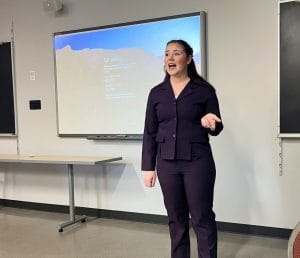
Holman, a first-year student from Franklin, Nebraska, is a member of the College’s forensics (speech) team. For Academic Showcase, the art and secondary education major delivered a persuasive and humorous speech addressing concerns about declining literacy rates and the growing role of AI in classrooms.
Academic Showcase, held each spring at Hastings College, provides students the opportunity to share presentations and performances with the community. Classes are canceled for the day to allow full participation.
Holman opened her presentation by outlining various forms of literacy — media, digital, critical, informational, reading and writing — before introducing research and data to support her claims.
According to a study done in 2025, literacy rates have been declining steadily since 2013, with increased technology use in classrooms cited as a contributing factor. This use, combined with the lack of regulations placed on school devices until recently, has taken away from students’ ability to do independent research.
“Only a fourth of eighth grade students are at the recommended reading level,” Holman stated.

She also addressed the lack of clear guidance for teachers navigating AI tools, noting that many are frustrated with students relying on platforms such as ChatGPT and Grammarly to complete assignments. These tools, both forms of generative AI, compile responses based on prompts, which can sometimes lead to misinformation or oversimplified information.
“Teachers love completed work,” Holman said, “but not at the cost of students lacking effort.”
Holman spoke out about educational disparities, such as how socioeconomic and racial factors can contribute to a lack of resources.
“These systematic barriers lead to higher AI usage,” she said. “Every time confidence in artificial intelligence increases, critical thinking decreases. If a child is constantly asking ChatGPT questions, they’re more likely to fall behind.”
In an attempt to lighten the mood, Holman added, “maybe it is those phones.”
Holman explained that while technology was introduced into classrooms before the pandemic, its use expanded significantly during the 2020 shutdown and has remained prevalent throughout platforms such as Google Classroom, Kahoot and Quizlet. She said some schools have reduced or eliminated spelling instruction due to the widespread use of grammar and spell-check tools.
The adoption of technology to make education easier or more efficient may have actually made it harder for teachers to do their jobs, Hollman argued. Students often learn from corrections and feedback because it forces them to reevaluate their work, but when AI generates the work, that feedback may not be applicable to the student.
Holman said artificial intelligence should be used as a tool rather than a replacement for learning. She suggested using AI to create discussion points or help with studying material through electronic flashcards, instead of generating a complete essay or providing test answers.
“AI is here to stay, so we must create a culture that understands AI,” Holman concluded.