
A curious cat wanders through a dark forest, drawn toward tiny points of colorful light glowing among the trees.
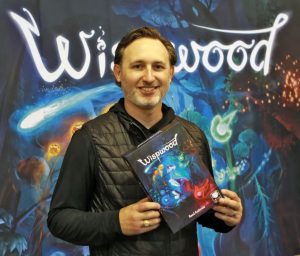
They are wisps, creatures with personalities and preferences all their own. And in Wispwood, a family-friendly, tile-laying board game created by Reed Ambrose ’10 of Abilene, Texas, players must figure out how to arrange wisp and tree tiles to build a magical forest and win the game.
For Ambrose, Wispwood represents the culmination of years of playing traditional games like Monopoly and chess.
“I grew up loving board games,” he said.
Then, in his 20s, he began exploring the world of hobby board games, modern designer games built around strategy, storytelling and social connection and sold online or in specialty game shops. In 2016, he attended his first BoardGameGeek convention in Dallas.
“That convention really hooked me,” said Ambrose, whose day job is working as a communications and content strategy specialist at Hardin-Simmons University in Abilene.
Learning the moves
Ambrose started small, entering board game design contests and gradually learning the craft. He joined a regular game group and met designers who had already been published. They became mentors of sorts, helping him understand not only how to make a better game but also how the publishing side of the industry worked.
“They really helped me elevate my craft and my understanding of being published,” he said. “They were instrumental in showing me the ropes and teaching me what they knew about the process.”
Ambrose pitched Wispwood at a 2024 speed-pitching event at the BGG Con in Dallas, an annual tabletop gaming convention hosted by BoardGameGeek, a popular online community and database. Like speed-dating but with tokens and tiles, designers moved from publisher to publisher, with about seven minutes to demonstrate prototypes of their games and make their pitch.
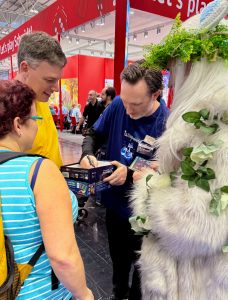
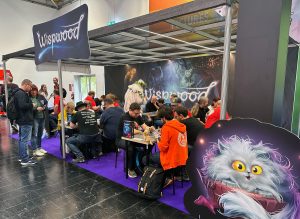
Czech Games Edition, a publisher based in the Czech Republic and well known in the hobby gaming industry, picked up Wispwood. The finished game made its debut in 2025 at Essen Spiel, the world’s largest board game convention, in Essen, Germany.
After years of evenings and weekends spent designing and testing games while raising two young sons with his spouse, Betsy, seeing Wispwood as a finished product was especially gratifying.
“To be able to show some kind of result for that was very rewarding,” Ambrose said.
The whimsical game, designed for 1 to 4 players ages 10 and up, has since been translated into French, Italian, Korean and eight other languages. It can be purchased in hobby game shops and online on Amazon and other sites.
A creative foundation
Ambrose’s path to game design began long before Wispwood, and he developed some of the skills he uses today — writing, designing and creative problem-solving — at Hastings College.
The Irving, Texas, native was drawn to the small college on the plains by its nationally-ranked men’s soccer program (he played from 2006 to 2010) and its strong program in English.
The late Dr. Anne Fairbanks, one of his English professors, made a lasting impression.
“She had a way of making me feel like my writing mattered. Her classes in general were always impactful for learning about writing and creativity,” he said. “I saw the benefit of going to a smaller school where you’re not just a number, and the professors know who you are. They care about you.”
Through the College’s personalized program, Ambrose planned his own course of study, a major called “Creative English and Advertising Design,” tailor-made to capture his interests in writing and the creative arts.
“I took a couple of graphic design courses at Hastings and even a class about comic books,” he said. “I think my interest in board games is kind of a conglomeration of all of those things, and I really enjoy the creative opportunities it provides.”
And there’s more to come.
A new game Ambrose designed, Cats vs. Ghostlings, has been signed by Envy Born Games in the U.S. It will launch on Kickstarter in early 2027, giving players and game shops an opportunity to preorder it and the publisher a way to gauge interest before a launch. Like Wispwood, it involves cats chasing lights (this time called ghostlings) through a forest.
Ambrose’s own creative chase has taken him from Hastings College classrooms to a pitch at BoardGameGeek in Dallas and finally to Wispwood, a whimsical game launched in Germany and now played by people around the world.
“It’s all very surreal,” he said.